We stopped the heat. Nobody meant to stop the rain.
In 2038 a fleet of stratospheric drones dimmed the sun. The killing heat ended, exactly as promised. The rain ended with it, and it has not fallen since.
It is now 2052, and you drive a relic car across the American Southwest, carrying a sealed package you were told not to open.
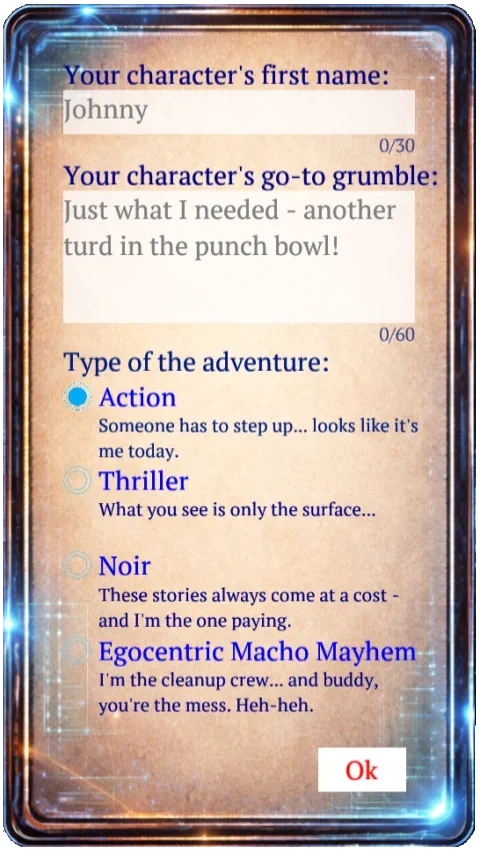
An interactive gamebook for phone and tablet. You read, you choose, and dice decide the rest.
Four books, one road. Action, noir, a conspiracy thriller, or full-throttle mayhem. Not a difficulty setting — every scene is written four times, and the drive feels different in each.
One purchase, nothing to buy inside. In development.
Dawn. You wake under the tarp — a dead haulage company’s truck curtain. The paint flaked off years ago, but the ghost of the lettering still hangs over your head: “…ICE-COLD. ALWAYS ON HAND.” Under it, a drawing of a sweating bottle, beads running down the side. You drank that, as a kid.
All night the canvas worked for you: the dew that settled on it ran down the fold and into the covered can. You drink the morning ration, check the level, and allow yourself the small pleasure — even after drinking, you have a liter and a half more than you had last night. A good night. You have no home. The car is home; water is life.
You climb out of the dugout where the van sits. Somebody cut it in the old world, and cut it in the right place: cool, out of the wind, invisible from the road. Around you the lines of foundations run through the sand, a stone jail with no roof, and further off a few grave markers with the names worn off them. There was a whole town down here on the flat — and it died first, before the one that grew up on the slope above it. On one stone you can still read what it was called: BULLFROG. Named after some water animal, they say. A frog. An amphibian. Here.
Above you to the northeast, at the top of the gravel slope, is Deepwell: the line of the ditch, the earth bank thrown up around the lower town, the forest of dew tarps on the roofs, a stunted patch or two of green. Higher still, on the mountainside, the Citadel — where the baron sits on top of the water. You don’t sleep inside the walls. You camp down here with the dead: free, and out in the open. The well belongs to the baron, and being inside costs.
A liter and a half is not a run west. That takes a proper advance, in water, in full cans. You strike camp and start uphill, toward the gate.
You pass between the Guests. They stand along both sides of the road, man-high, shrouded, white — canvas and plaster over a frame. The old world put them here and nobody remembers what for. A couple have gone down over the years; the rest are still standing. They are hollow. Lift the shroud and there is nothing underneath. Nobody touches them. Neither do you. You just slow down, the way you always do.
Then the sand starts talking. A wide band of tracks, trampled into a fan by hundreds of feet: a crowd pressed up to the gate and then scattered into nothing. Dried-out canteens thrown aside. A darker patch where the sand was churned. A whole well’s worth of people stood here yesterday, children and all, and were turned away. The desert does the rest. Their leader would not back down, kept the others burning; that is where the bullet went. Ammunition is short everywhere now — anyone who spends a round on a man is sending a message with it. You watched from under the tarp. They dragged the body off before dark; nothing dead stays near water. The wind has already started on the tracks. By tomorrow there will be nothing left of them.
Someone should put a stop to this. You don’t dwell on it — but it rides with you up the slope.
Ahead: the gate. A ramp over the ditch, a gap in the bank, Sift at the post. The usual routine.
The gate of Deepwell sits at the south end of town: beside the house built out of bottles — the Glasshouse — a gap in the bank, the ditch in front of it, the packed ramp across. Sift is at the post. He knows you: a look over the van, a lazy hand through the cargo bay — the usual junk, drones, cans, the gun on the roof — and he is already waving you through.
On the wall, the notice. Faded, but readable:
POSSESSION OF A FUNCTIONING AI IS A VIOLATION OF THE TOWER LOCKDOWN ACCORD. REPORTING IS MANDATORY.
Underneath, in handwriting: Reward for reporting — 50 liters of water.
Sift follows your eyes and spits. “All that wire took the sky off us, and now they’d drink our water too. Let the lot of them die.”
Then, half to you: “Anybody who speaks up when they see one — we don’t forget that here. Fifty liters. And my goodwill.”
What do you say?
You spit the hatred back. Sift grins and nods: you are one of them, and that gets remembered. From now on you have a friend at the gate, and goodwill like that can be worth having.
It is easy to hate something you have never seen, when you hate it together. What it cost you was a piece of yourself.
Sift skims a little charge off you as a toll — small change, in your line of work — and waves you on. You bump across the ramp and in through the gap in the bank: the noise of the Exchange, the ration line, the dew market, and above all of it, on the mountainside, the Citadel, where the water comes down from.
You drive in.
You keep it flat: “I need work, nothing else.” Sift shrugs; your lack of enthusiasm is no business of his. You are filed as neither good nor bad.
He skims a little charge off you as a toll — small change, in your line of work — and waves you on. You bump across the ramp and in through the gap in the bank: the noise of the Exchange, the ration line, the dew market, and above all of it, on the mountainside, the Citadel, where the water comes down from.
You drive in.
You let it go past you. Sift mutters something about wireheads — and remembers you for it, the wrong way: anyone who won’t spit on the wireheads gets measured with suspicion. That silent face of yours will not be forgotten.
He skims a little charge off you as a toll — small change, in your line of work — and waves you on. You bump across the ramp and in through the gap in the bank: the noise of the Exchange, the ration line, the dew market, and above all of it, on the mountainside, the Citadel, where the water comes down from.
You drive in.
The Exchange is in the ruin of the old school, just inside the gate: two floors, half a roof, and the mark on the wall where the slate board used to hang. Inside is the job wall — scraps of board nailed up, the work scratched into them.
You read down the list. Salt from the salt flat. An escort leaving tomorrow. Then the lowest one, freshly scratched: sealed case, toward the coast, do not open it. Underneath it, the price — and the price stops you.
An advance now; at the far end, a fresh cell and real food. Three times the going rate. What pays like that is contraband. Everybody knows it, nobody says it.
Reba stands behind the deposit counter, the chits and the split tokens laid out in front of him. He is not your friend; on any other day he would short you, and you both know it. Today he is in a hurry, and doesn’t bother hiding it: he keeps glancing at the door while he talks.
“You’re headed for the coast anyway.” Not a question.
Then he slides the chit across the counter and puts his hand flat on it. “The advance comes out of the deposit. Whatever extra you take now, you won’t have at the end. How you ration it is not my business.”
You push. The coast is two weeks there and back if nothing goes wrong; past the marsh there isn’t a well you’d trust; your cans are not made of rubber.
Reba doesn’t interrupt. He just watches, and calculates — you can see it on his face, the rest of the fee being shifted around in his head.
In the end he grunts, strikes out the number on the chit and writes a bigger one above it. Then he picks up the token and cuts the remainder down too — smaller.
“Don’t look at me with big eyes at the far end,” he says, already scanning past you for the next one in line.
You don’t go for the advance.
“Why today? And why me?”
Reba’s hand stops on the chit. For a moment he doesn’t look up — just long enough for you to know the question landed.
Then he shrugs, as if it made no difference. “Somebody west of here is waiting for it, and is very short of time. It didn’t come through the usual channel — an old man brought it in, barely able to stand, and didn’t argue over a single word. Only said it has to go fast, and that it should be carried by somebody nobody looks at twice.”
He shrugs again, and this time he means it. “That’s you. That’s why.”
He pushes the chit across, and half the split token, and then the case.
It is heavier than it looks. Smooth, dark, the seal intact; no handle, no marking. As you set it down on the passenger seat it tips for a moment — as if there were something inside that hadn’t slid where the weight said it should.
You don’t think about it any further. You roll out onto Main Street and head uphill, to the counter where the water gets measured out against it.
The gate is already yellowing at the end of the dusty street, the bounty notice on the wall beside it: POSSESSION OF A FUNCTIONING AI — REPORTING IS MANDATORY. Fifty liters of water for one word.
And then, as if the notice had called it up, the sealed case on the passenger seat grows warm. A sound leaks out of it — half a word, barely more than static, and unmistakable. You are alone in the car; nobody hears it but you. The cold goes down your back as it comes together in your head: it isn’t contraband. It’s alive. And you are carrying it toward the gate, under that notice.
There is nowhere to turn back to. You are at the gate, the eyes are already turning your way. There is no time to think. You set your jaw, swallow whatever would show on your face, and roll on.
The road goes on. This page doesn't.
Leave your email address, and it comes to you — one stop every two weeks, seven in all: a real place, and the decision waiting there when you arrive. Then silence until there's something to play.
The first arrives as soon as you confirm. Subscribers get the playable opening first. One click to leave, any time.
The springs above Furnace Creek still run, and nobody drinks from them any more. Since 2008 the water people drink there has come up out of three wells — through pumps, through a treatment plant, and through the hands of whoever keeps both running.
All of that is true today. The book adds one thing: nobody left to do that job.
Every place in this book is real. Every two weeks you get one of them: what is actually there — the spring, the ruin, the numbers, the coordinates you can open in a map — and the decision the book puts in front of you when you arrive.
What that decision costs, you find out when you play. Seven letters, then silence until there is something to try. Subscribers get the playable opening first.
You'll get a confirmation email first — the list only stores addresses that confirm. One click to unsubscribe. See the privacy notice.
The long version: what a real place turns out to be when you check it.
They have been walking toward a well that ran dry a month ago, and you are the first vehicle they have seen in two days.
One gold strike in 1905 produced three towns on the same ridge. This is the one that didn't make it, and it is still up there, in pieces.
I needed one location to be abandoned, and I kept inventing reasons for it. The tell was that a new constraint arrived exactly when the previous one died.